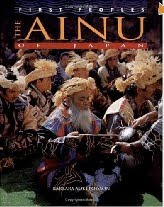
Traditionally, the most important duty of an Ainu man was to carve the inaw. Inaw are the sacred shaved sticks that symbolize birds, and which were believed to deliver human prayers to the gods or chase away demons. Carving inaw involves stripping the outer bark from a tree limb (often willow or dogwood), then shaving the wood underneath so that it forms bunches of paper-thin curls attached at one end. This is time-consuming work and requires both a steady hand and a special carving tool called an inaw-kemakiri. The design and shape of the inaw depends on the particular god to which the prayers are being addressed, and the ceremony in which they are going to be used. Once used, they are never reused, but left where they have been placed until they fall into decay (or burned, if the inaw is for the fire god) after a single use. Inaw have a graceful, understated beauty that contrasts with other Ainu designs, which tend to be visually "busy" and stimulating. (ref: Ainu: Spirit of a Northern People and Sapporo Pirika Kotan museum)


 Posts
Posts