Several years ago, I was invited to write about the "birth" of Project U-e-peker for ikjeld.com, a website for Japan-based news. I've pasted the bulk of the essay below. You can find the original article at http://www.ikjeld.com/japannews/00000457.php.
"Project U-e-peker came into being on February 9, 1999, when three people of different nationalities and professions gathered at my home in Sapporo to discuss what we could do to make Ainu folk tales more readily available in English-- particularly in the light of the potential resources of the recently established Foundation for Research and Promotion of Ainu Culture (hereafter: Ainu Foundation).
Our team rep, Hakodate-based Peter Howlett, had been using his own translations of Ainu folk tales in his ESL (English as a second language) syllabus for years, developing teaching materials that included notes in various languages (primarily Japanese, Korean, and Russian) so that they could be used beyond the context of Japan's ESL classroom, as part of a vision to create "classrooms without borders."
Noriyoshi Owaki, retired English teacher, former president of the Minority Group Conference, and secretary general of the National Network in Support of the Ainu Communal Property Case, approached our project from the perspective of preserving Ainu dignity and ethnic rights.
As a professional translator, my own approach to the project was a deep interest in the oral literature of an overlooked and under-appreciated culture. Like Peter, I had lived all my life in Japan, most of it in Hokkaido, in close proximity to the few remaining Ainu hamlets. Our physical appearance and nationalities had forced us to be categorized as outside the mainstream in the land we have called "home" for over fifty years, and maybe this is one reason why we were drawn so by the plight of the Ainu.
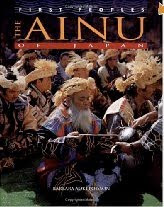
With each subsequent meeting, the membership of Project U-e-peker grew, encompassing more nationalities, professions, and perspectives along the way. Our first breakthrough came when Peter's translation of Ainu Nenoan Ainu was published by Tuttle Publishing as The Ainu: A Story of Japan's Original People (2004). Originally written by the Ainu activist Kayano Shigeru (1926-2006), it is a meticulously illustrated description of the traditional Ainu lifestyle and values in which he had been raised.
In 2005, the Ainu Foundation accepted our application for a publishing grant, and my translation of Ainu to Kitsune, Kayano's rendition of a traditional Ainu folk tale, was published by R.I.C. Publications as The Ainu and the Fox (2006). We hope to eventually publish our English renditions of the tales in Chiri Yukie's (1903-1922) famous yukar anthology, titled Ainu Shinyoushuu (Collected tales of the Ainu gods).
In 2006, shortly after the publication of The Ainu and the Fox, we established a Project U-e-peker website to inform the public of what we hope to accomplish and why. We are spread over several nations and continents, but our common desire is to have a part in drawing the world's attention to the literary charm and social/ecological wisdom contained in the Ainu oral tradition, before it is snuffed out in the general apathy which faces it in Japan."


 Posts